In the largest analysis, 178 studies with 5097 participants, heavy programmes with several sets, at 80 per cent of your maximum or more, scored best for strength. Lighter training makes you stronger too. Train the movement you want to get stronger at and gradually add load or reps. Training to failure proved unnecessary for strength.
You get stronger by lifting heavy, with several sets per exercise. In the largest analysis to date, 178 studies with 5097 participants, such programmes at 80 per cent of your maximum or more scored best for strength. Lighter programmes also made people clearly stronger.
Three more things count. You train the movement you want to get stronger at, because strength gains are largely specific. You add load or reps step by step. You give yourself enough rest between heavy sets. Training to failure proved unnecessary for strength.
That is the short answer. Below you will find, lever by lever, what was measured, how large the differences really are and where the studies are less definitive than the headlines on social media.
In 2023 a research group at McMaster University in Canada brought together the randomised trials of at least six weeks that compared load, number of sets and training frequency in healthy adults. For strength that meant 178 studies with 5097 participants, 45 per cent of them women.
Heavy there meant at least 80 per cent of the weight you can lift once. According to the conversion the researchers themselves used, that is a weight you can lift eight times at most. The top-ranked programme for strength was heavy, several sets per exercise, three or more times a week.
Of the 66 head-to-head comparisons for strength, only 9 showed a clear difference. Every one of them was heavy training with several sets against a lighter programme.
A second network analysis limited to sets taken to failure, 28 studies with 747 participants, reaches the same result. A weight you can lift at most eight times and a weight for 9 to 15 reps both built more strength than a weight for more than 15 reps. Between heavy and moderate a small advantage for heavy remained that was not significant (p=0.068).
Source: Currier et al.1 2023, British Journal of Sports Medicine · Lopez et al.2 2021, Medicine & Science in Sports & Exercise
Knowing how to get stronger is one thing. Hitting those heavy sets every week, with enough sleep and food that supports the work, is another. The free health check shows you in five minutes where your biggest leak is. Take the free health check
In the same analysis of 178 studies almost every programme clearly beat no training at all. The programmes sat close together: in 101 of the 111 comparisons, strength and muscle size combined, the researchers could not demonstrate a clear difference.
A meta-analysis of 21 studies in which every set went to failure drew the line lower: heavy there meant anything above 60 per cent of your maximum. With that heavier weight the gain on the maximal lift was larger. On isometric strength, pushing against something that does not move, there was no significant difference. Muscle grew equally well with light and heavy loads.
Even when total volume is equalised, sets times reps times weight, heavy stays best for your maximum. An analysis that did exactly that arrived at the same order: heavy above moderate, moderate above light.
If you train with a sensitive joint or are restarting after a long break, that is reassuring. Lifting lighter costs you a little on your maximal lift. It still builds a lot of strength.
Source: Currier et al.1 2023, British Journal of Sports Medicine · Schoenfeld et al.3 2017, Journal of Strength and Conditioning Research · Carvalho et al.4 2022, Applied Physiology, Nutrition, and Metabolism
This may be the most useful insight in this whole body of evidence. Strength gains are largely specific to the movement you train.
A meta-analysis of 43 studies with 1660 participants measured two things after ordinary strength training: strength on the trained exercise and strength of the same muscles in an isometric test that was not trained. The effect on the trained exercise was more than twice as large, a standardised effect of 0.98 against 0.42. How much the muscles grew did not demonstrably predict that strength gain.
A small American study took that to the extreme. Thirty-eight untrained people trained the leg extension and the chest press for eight weeks. One group did four sets to failure. The other only tried to lift its maximum once each session, with five attempts at most. The first group gained more muscle. On the maximal lift there was no difference: on the leg extension 1.0 kilo, with a 90% confidence interval of minus 0.7 to 2.8 kilos.
So testing nothing but maxima builds less muscle. The participants were also beginners over eight weeks. If you want a stronger squat, heavy squats belong in your programme.
Source: Saeterbakken et al.5 2025, Sports Medicine · Mattocks et al.6 2017, Medicine & Science in Sports & Exercise
Failure means the next rep no longer goes up with good technique. It feels like the only honest set. For strength the research is fairly clear: you do not need it.
A meta-analysis of 15 studies found no difference in strength gains between training to failure and stopping before failure. In the studies where volume differed between groups, stopping before failure even did better for strength. That last point is a subgroup, so read it as a hint.
A series of meta-regressions from 2024 estimated, study by study, how many reps the participants still had in reserve. For strength it hardly mattered. Muscle grew more as sets ended closer to failure. The authors call their own analysis exploratory. The reserve was also estimated after the fact from the study descriptions.
A heavy set where you still have one to three reps left therefore sits well within what worked just as well for strength in these studies.
Source: Grgic et al.7 2022, Journal of Sport and Health Science · Robinson et al.8 2024, Sports Medicine
Rest is the first lever to go when your diary is full. Thirty seconds between two sets feels efficient.
A systematic review of 23 studies with 491 participants looked at what rest duration does to strength gains over weeks. Even with short rest, under a minute, training clearly built strength. In trained lifters, more than two minutes seemed necessary to maximise gains. For beginners one to two minutes seemed to be enough. The review gathered the studies without pooling them statistically.
Probably part of the reason is that with too little rest you lift less weight or manage fewer reps in your next set. That is exactly the stimulus you were after.
One caveat: 413 of the 491 participants were men. In women this has been measured far less often.
Source: Grgic7, Schoenfeld et al.3 2018, Sports Medicine
The principle is older than any study. The Roman orator Quintilian uses as a school example a sentence about the famous wrestler Milo of Croton: having grown used to carrying a calf, he carried a bull. An anecdote, with an idea that still holds: your body adapts when it is asked for a little more than last time.
How you organise that little more was tested in 2022. In a randomised trial, 43 people with at least a year of experience trained their legs twice a week for eight weeks. One group added weight and kept the reps the same. The other kept the weight the same and did more reps each time. Thirty-eight participants completed the study.
Both groups gained about 20 kilos on the squat: 21.8 kilos by adding weight, 19.3 kilos by adding reps. After adjusting for starting level, a difference of 2.0 kilos in favour of weight remained. The researchers themselves describe it as of questionable practical significance, with a 90% confidence interval of minus 2.4 to 7.8 kilos.
Two details to weigh. Training used a free squat and testing used a guided squat machine. The researchers themselves allow that this set-up may hide a difference between the groups. Many participants did not squat regularly either, so part of the gain is probably learning the movement.
So if you cannot add a kilo this week, an extra rep is progress too.
Source: Plotkin et al.10 2022, PeerJ
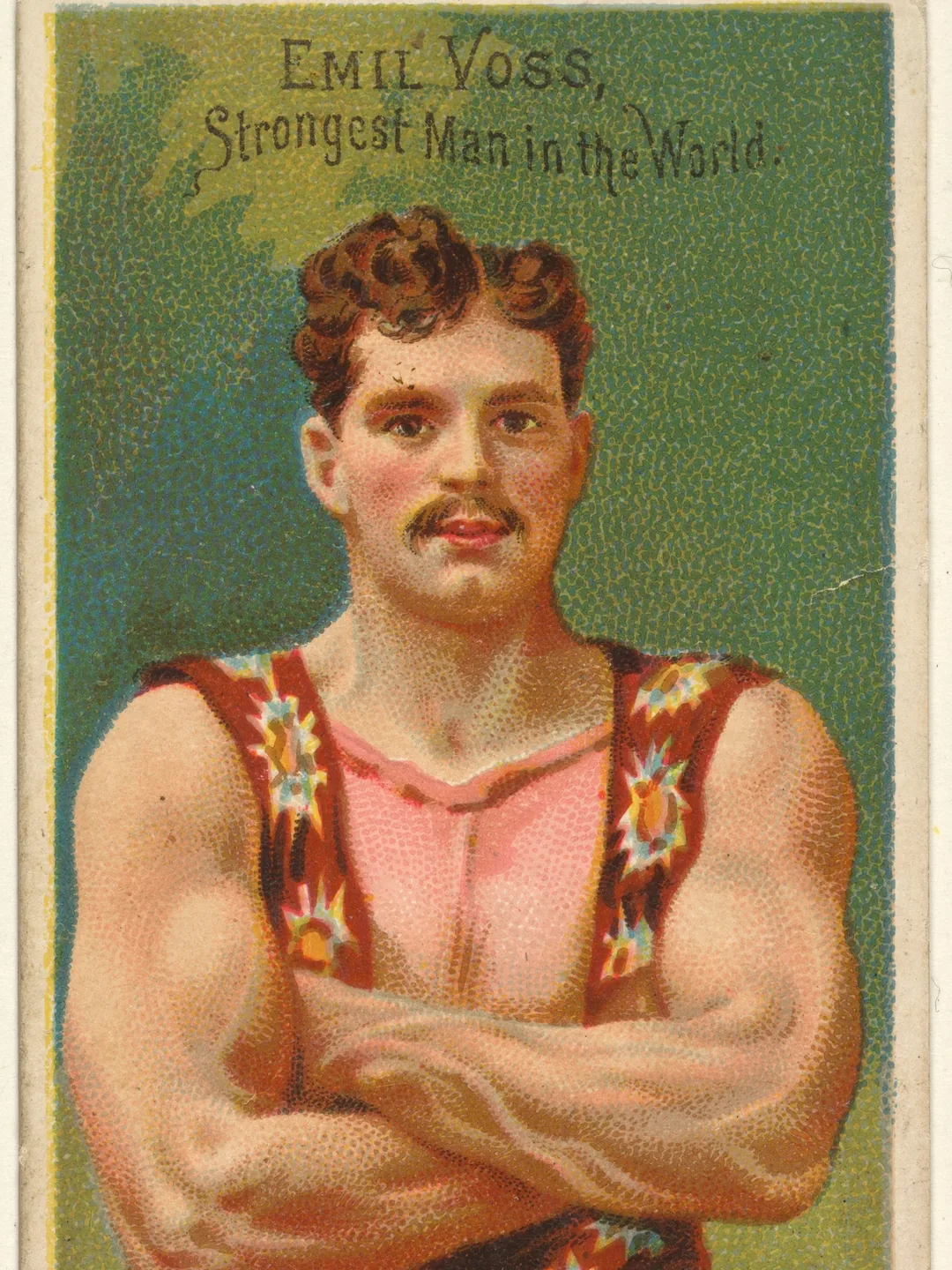
As a historian I look at two things in every file: what interests the authors had and who was in the study group. The image at the top is a fine example in itself. The strongest man in the world, used in 1888 to sell cigarettes.
Two of the ten authors of the progression study worked for a company that sells training and nutrition programmes. In the meta-analysis on light versus heavy lifting, two of the four authors were affiliated with a commercial company. One name also keeps coming back: the same American researcher is an author on five of the ten sources in this article.
Such a tie is a reason to check whether other groups find the same. For light versus heavy they do: two network analyses by other groups arrive at the same order. The progression study has not yet been replicated.
The study group is the second point. In the review on rest periods 84 per cent of the participants were men. In the largest network analysis 45 per cent were women. The conclusions on heavy lifting therefore rest on a mixed group, those on rest mainly on men. The meta-analysis on training to failure included young adults only.
Source: Plotkin et al.10 2022 · Schoenfeld et al.3 2017 · Grgic7, Schoenfeld et al. 2018 · Currier et al.1 2023
Line the levers up and you get a simple programme. Every main exercise gets heavy sets where you still have one to three reps left. You rest long enough between them to start the next set just as strong. You write down every set, so next week you know where a kilo or a rep can go on.
How many times a week to do it is covered in the article on training frequency.
In practice it goes wrong in the week when three sessions become two and your notes stay at home. That is the subject of the page on getting stronger.
| Lever | What the research measures | Where it comes from |
|---|---|---|
| Load | heavy sets (80 per cent of your maximum or more) with several sets per exercise scored best | network analysis of 178 studies |
| Reps | a weight you can lift at most 8 times or 9 to 15 times built more strength than a weight for more than 15 reps | network analysis of 28 studies |
| Specificity | gain on the trained exercise more than twice that on an untrained isometric test | meta-analysis of 43 studies |
| To failure | no extra strength; possibly a little extra muscle according to an exploratory analysis | meta-analysis of 15 studies and meta-regressions |
| Rest | trained: more than two minutes seemed necessary; beginner: one to two minutes seemed enough | review of 23 studies |
| Progression | adding load or adding reps both gave about 20 kilos on the squat | eight-week randomised trial |
In an analysis of 178 studies with 5097 participants, heavy programmes with several sets per exercise scored best for strength, heavy meaning 80 per cent of your maximum or more. Most programmes sat close together. Lighter training also makes you clearly stronger, with slightly smaller gains on your maximum.
In a network analysis of 28 studies, a weight you can lift at most eight times built more strength than a weight for more than 15 reps. A weight for 9 to 15 reps also beat that light weight. Between heavy and moderate the difference was small and not significant.
No. A meta-analysis of 15 studies found no difference in strength gains between going to failure and stopping before it. An exploratory analysis from 2024 suggests that training close to failure adds a little muscle.
In people who already train, more than two minutes of rest seemed necessary to maximise strength gains. For beginners one to two minutes seemed to be enough. That comes from a review of 23 studies with 491 participants, 413 of them men.
Yes, to a lesser degree. In a meta-analysis of 43 studies, the gain on the trained exercise was more than twice the gain on an untrained isometric test of the same muscles. If you want to get stronger on a particular lift, that lift belongs in your programme.
No. In a randomised trial in trained people, both groups gained about 20 kilos on the squat in eight weeks, whether they added load or reps. The researchers called the adjusted 2 kilo difference in favour of load of questionable practical significance.
Timon offers online coaching, wherever you live. Prefer to build on your own first? Start with Het Fundament. Coaching clients can also train with him in person in Maldegem and Ghent.
Leave a comment below. Say what you think, or tell me which claim to look into. Your comment appears right away and everyone can read it.
What I researched that week, summed up in three sentences, sources included. Unsubscribe any time.
Every number in this article was checked against the original publication.
This article is information, not medical advice. If you have symptoms, are pregnant or take medication, talk to your doctor before changing anything.
During the first three to four weeks, much of what you measure may be swelling. According to a researchers' model, real muscle growth starts after about eighteen sessions. After a few months, controlled studies land on average at a little under a kilo of extra lean mass, with huge differences between people.
Read the article
Twice a week is enough for most people. With the same number of sets, spreading them over one, two or three sessions makes little difference to muscle mass. For strength, the most recent research points to a possible advantage for training more often. The practical minimum is four sets per muscle group per week. For more muscle mass, the newest position stand recommends ten sets or more.
Read the articleTwenty questions, five minutes and your report appears right away: your Health Score, your Biggest Leak and your First Building Point. Backed by 120+ scientific studies.